Gurmukhi Font Style
x
Home
Search
Upload
Punjabi Font Converter
☰
Introduction to Sikh Military History
The Sikh faith, founded by Guru Nanak in the 15th century, transformed into a martial tradition under Guru Hargobind and especially Guru Gobind Singh. The creation of the Khalsa in 1699 marked the formal establishment of a warrior-saint community dedicated to fighting tyranny and protecting the innocent.
Under Maharaja Ranjit Singh in the early 19th century, the Sikhs built a powerful empire that stretched across Punjab and beyond, before facing British expansion.

Sikh warriors charging into battle
:max_bytes(150000):strip_icc()/Guru_Gobind_Singh_crossing_the_Sarsa-5903d29c5f9b5810dc656b43.jpg)
Guru Gobind Singh leading the Khalsa
Sikh military history is deeply rooted in the spiritual philosophy of Sikhism itself. Founded by Guru Nanak in the late 15th century, Sikhism initially emphasized devotion, equality, and social justice. However, as Sikh communities faced increasing persecution under Mughal authority, the faith evolved to include the necessity of self-defense. This transformation was not a departure from spirituality, but an extension of it.
The concept of Miri-Piri, introduced by Guru Hargobind Sahib, laid the foundation for Sikh militarization. It symbolized the balance between temporal power (Miri) and spiritual authority (Piri), establishing that protecting righteousness sometimes requires the use of force. Guru Hargobind organized armed Sikhs, built the Akal Takht, and trained followers to defend both faith and freedom.
This evolution reached its defining moment under Guru Gobind Singh Ji. In 1699, the formation of the Khalsa transformed the Sikh community into a disciplined, collective force bound by faith, equality, and courage. The Khalsa rejected caste distinctions and personal ambition, replacing them with a shared identity and a moral duty to resist oppression. Every initiated Sikh became both a saint and a soldier.
Unlike conventional armies, the Sikh military tradition emphasized ethical warfare. Civilians were to be protected, places of worship respected, and the weak defended. Victory was never seen as justification for cruelty. This moral code distinguished Sikh warriors from many contemporary forces of the time.
Throughout the 18th century, Sikh forces endured relentless campaigns of persecution. Despite facing massacres, forced migrations, and attempts at annihilation, the Sikhs reorganized into mobile warrior bands known as misls. These groups operated with remarkable resilience, conducting guerrilla warfare while maintaining religious unity.
The unification of these misls under Maharaja Ranjit Singh marked the rise of the Sikh Empire. His reign combined military modernization with religious tolerance. European officers were employed to train the army, modern artillery was developed, and a standing force was maintained— yet freedom of worship was guaranteed to all subjects, regardless of faith.
Sikh military history, therefore, is not merely a record of battles and empires. It represents a unique synthesis of faith, discipline, resistance, and ethical responsibility. From spiritual beginnings to imperial power, the Sikh martial tradition remains one of the most distinctive in world history.

Sikh warrior
Sikh-Mughal Wars (17th–18th Centuries)
These conflicts arose from religious persecution under Mughal rule. Guru Hargobind first raised arms, and Guru Gobind Singh fought numerous battles to defend Sikh sovereignty and faith.
- Battle of Bhangani (1688) – Guru Gobind Singh defeats hill chiefs allied with Mughals.
- Battle of Chamkaur (1704) – 40 Sikhs face massive Mughal army.
- Siege of Anandpur Sahib (1700–1705) – Prolonged defense against overwhelming forces.
- Formation of Dal Khalsa (1748) – Organized Sikh confederacy to resist oppression.
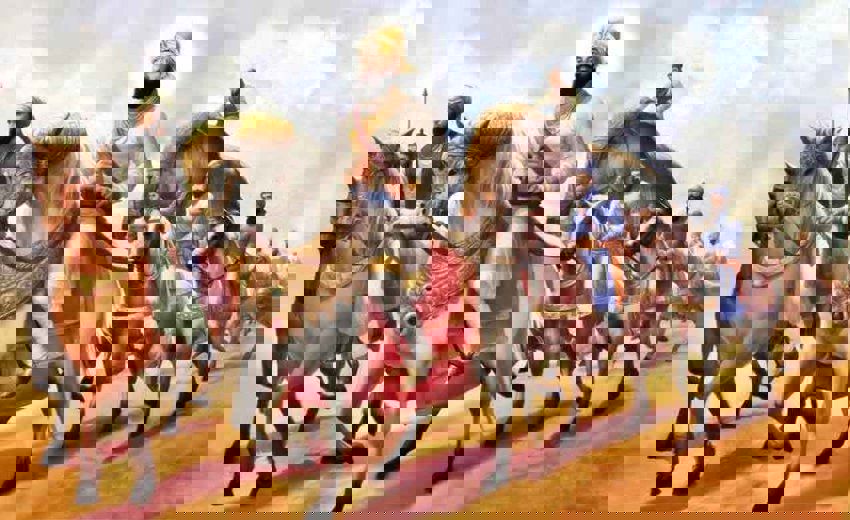
Guru Gobind Singh leading Khalsa warriors
The Sikh–Mughal Wars were among the most defining struggles in early modern Indian history. They were not simple territorial conflicts, but prolonged confrontations driven by religious persecution, political dominance, and the Sikh commitment to resist tyranny. As Mughal authority became increasingly intolerant toward non-conforming religious communities, the Sikhs were forced to defend their faith, institutions, and right to exist.
The militarization of the Sikh community began under Guru Hargobind Sahib in the early 17th century. In response to the execution of Guru Arjan by Mughal authorities, Guru Hargobind adopted the doctrine of Miri-Piri, asserting that spiritual authority must be matched by temporal power. This marked the first organized Sikh resistance to Mughal oppression and laid the foundation for future conflicts.
Under Guru Gobind Singh Ji, Sikh resistance evolved into a structured and ideological struggle. The creation of the Khalsa in 1699 transformed Sikhs into a disciplined collective bound by faith, equality, and a moral obligation to confront injustice. The Mughal state viewed this growing unity and independence as a direct threat to imperial control.
The Battle of Bhangani (1688) was the first major military engagement fought by Guru Gobind Singh. Despite limited resources, Sikh forces decisively defeated hill chiefs aligned with Mughal interests. The battle demonstrated early Sikh military organization and the Guru’s ability to unite warriors under a common cause.
The prolonged Siege of Anandpur Sahib (1700–1705) became a turning point in Sikh history. Mughal forces, supported by hill rulers, surrounded the Sikh stronghold for years, cutting off supplies and subjecting civilians to extreme hardship. Despite sworn promises of safe passage, Mughal authorities violated agreements, leading to intense battles and the eventual evacuation of Anandpur under treacherous conditions.
The Battle of Chamkaur (1704) stands as one of the most iconic last stands in military history. A small group of Sikhs defended a fortified position against an overwhelming Mughal army. Here, Guru Gobind Singh’s elder sons, Ajit Singh and Jujhar Singh, attained martyrdom, symbolizing ultimate sacrifice in defense of faith and righteousness.
Following the death of Guru Gobind Singh in 1708, Sikh resistance did not fade. Instead, it intensified under leaders like Banda Singh Bahadur, who launched widespread uprisings against Mughal authority, dismantled feudal systems, and redistributed land to the oppressed. Although Banda Singh was eventually captured and executed, his campaigns permanently weakened Mughal control in Punjab.
By the mid-18th century, Mughal power was in decline, but persecution continued under various governors. In response, Sikh forces reorganized into a unified structure with the formation of the Dal Khalsa (1748). This confederacy coordinated military operations, protected Sikh shrines, and defended civilians against repeated invasions and state-sponsored violence.
The Sikh–Mughal Wars fundamentally reshaped the political and military landscape of northern India. They forged a resilient warrior tradition grounded in ethical resistance, ensured the survival of the Sikh faith during its most vulnerable period, and ultimately paved the way for Sikh sovereignty in the 18th century.
Afghan-Sikh Wars (1748–1837)
The Afghan-Sikh Wars were a series of intermittent conflicts between the Durrani Empire (Afghans) and the Sikh forces, spanning from 1748 to 1837. These wars originated from Afghan attempts to dominate the Punjab region after the decline of Mughal power, met with resilient Sikh resistance that eventually led to the rise of the Sikh Empire under Maharaja Ranjit Singh.
Early Invasions by Ahmad Shah Durrani (1748–1767)
Ahmad Shah Durrani, founder of the Durrani Empire, launched multiple invasions into India to extract tribute and assert control. His first major incursion in 1748 saw him capture Lahore, but Sikh forces under the Dal Khalsa began guerrilla warfare, harassing Afghan supply lines.
In 1756-57, Ahmad Shah sacked Delhi and committed massacres in Punjab, but Sikhs regrouped and raided his forces. After his victory at Panipat in 1761, Sikhs attacked his retreating army, reclaiming Lahore briefly.
The most devastating event was the Vadda Ghallughara (Great Holocaust) in 1762, where Ahmad Shah's forces massacred around 25,000-30,000 Sikhs, including women and children, near Kup Rahira. Despite this, Sikhs recovered remarkably, defeating Afghans at Sirhind in 1763-64 and expanding their territories.
Ahmad Shah's later invasions in 1764-67 were less successful as Sikh Misls (confederacies) grew stronger, capturing key areas and forcing him to retreat.
Depiction of Afghan-Sikh Wars
Timur Shah and Zaman Shah's Reigns (1772–1800)
After Ahmad Shah's death in 1772, his son Timur Shah continued invasions but faced defeats, such as in 1779 when Sikhs captured Multan briefly. By the 1780s, Sikhs had consolidated power in Punjab.
Under Zaman Shah (1793-1800), further attempts to invade were thwarted by internal Afghan issues and Sikh unity. Maharaja Ranjit Singh began unifying the Misls around this time.
Rise of the Sikh Empire and Offensive Campaigns (1801–1837)
In 1799, Ranjit Singh captured Lahore and proclaimed the Sikh Empire in 1801. He modernized the army with European tactics and expanded westward.
- Battle of Attock (1813): Sikhs under Diwan Mohkam Chand defeated Afghan forces, capturing the strategic fort.
- Conquest of Multan (1818): After a siege, Sikhs under Misr Diwan Chand captured Multan from Afghan governor Muzaffar Khan.
- Battle of Shopian (1819): Sikhs defeated Jabbar Khan, annexing Kashmir.
- Battle of Nowshera (1823): Ranjit Singh's forces crushed Pashtun tribes and Afghan allies, securing the Peshawar Valley.
- Battle of Jamrud (1837): The last major clash; Sikhs under Hari Singh Nalwa held off a large Afghan army led by Akbar Khan, though Nalwa was killed. This battle marked the effective end of Afghan threats to Punjab.
By 1837, the Sikh Empire had annexed key Afghan territories, including Peshawar, Kashmir, and the Khyber Pass, significantly weakening Durrani influence in the region.
Illustration from the Afghan-Sikh Wars

Maharaja Ranjit Singh with his forces
Anglo-Sikh Wars (1845–1849)
After Ranjit Singh's death, internal divisions and British expansion led to two major wars that ended Sikh sovereignty in Punjab.
- First Anglo-Sikh War (1845–46) – Battles of Mudki, Ferozeshah, Aliwal, Sobraon. Ended with Treaty of Lahore.
- Second Anglo-Sikh War (1848–49) – Battles of Chillianwala (Sikh tactical success) and Gujrat; led to full annexation of Punjab.

Battle of Ferozeshah during First Anglo-Sikh War
The Anglo-Sikh Wars were not sudden conflicts, but the result of a gradual power struggle between the Sikh Empire and the expanding British East India Company. Under Maharaja Ranjit Singh, the Sikh Empire had maintained a strong, modernized army and successfully checked British ambitions along its borders. His death in 1839, however, created a dangerous vacuum of leadership.
Following Ranjit Singh’s passing, rapid successions, palace conspiracies, and internal rivalries weakened the central authority of Lahore. Court politics became dominated by factions, while the Khalsa Army—once fiercely loyal—grew increasingly autonomous and suspicious of both the British and the Sikh nobility. This instability gave the British an opportunity to intervene under the pretext of maintaining order.
The First Anglo-Sikh War (1845–1846) revealed the exceptional fighting capability of the Sikh army. Despite poor coordination at the highest command level and alleged betrayals by Sikh generals, Sikh soldiers inflicted heavy casualties on British forces. Battles such as Ferozeshah and Sobraon demonstrated disciplined artillery use and battlefield resilience rarely seen against British troops in India.
However, political treachery proved decisive. Key Sikh commanders failed to act decisively at critical moments, allowing British forces to recover. The resulting Treaty of Lahore stripped the Sikh Empire of territory, imposed heavy indemnities, and placed British officials in Lahore—effectively reducing the empire to a client state.
The fragile peace soon collapsed into the Second Anglo-Sikh War (1848–1849). This conflict was sparked by local resistance in Multan but quickly escalated into a full-scale rebellion against British dominance. Unlike the first war, this was a popular uprising supported by large sections of the Khalsa Army.
The Battle of Chillianwala remains one of the most fiercely contested engagements in British Indian history. Sikh forces fought with remarkable determination, inflicting severe losses and shaking British confidence. Although often labeled a British victory, it was widely regarded at the time as a moral and tactical success for the Sikhs.
Ultimately, superior British logistics, reinforcements, and centralized command prevailed at the Battle of Gujrat. In 1849, Punjab was formally annexed, ending Sikh sovereignty and dissolving the Khalsa Army as an independent force.
Despite defeat, the Anglo-Sikh Wars left a lasting legacy. British officers openly acknowledged the courage, discipline, and martial skill of Sikh soldiers. Ironically, many former Sikh warriors were later recruited into the British Indian Army, where they earned a reputation as one of its most formidable fighting forces.
The wars stand as a powerful reminder that the fall of the Sikh Empire was not due to lack of bravery or military strength, but to internal divisions and calculated colonial strategy.

Scenes from the First Anglo-Sikh War
Legendary Last Stands & Heroic Battles
Sikh history includes extraordinary examples of bravery against impossible odds.
- Battle of Saragarhi (1897) – 21 Sikhs defend against 10,000 Afghan tribesmen.
- Battle of Chamkaur (1704) – Guru Gobind Singh and 40 Sikhs vs. massive Mughal force.
- Battle of Amritsar (1764) – 30 Sikhs defend Harmandir Sahib against 30,000 Afghans.

Heroic defense at Saragarhi
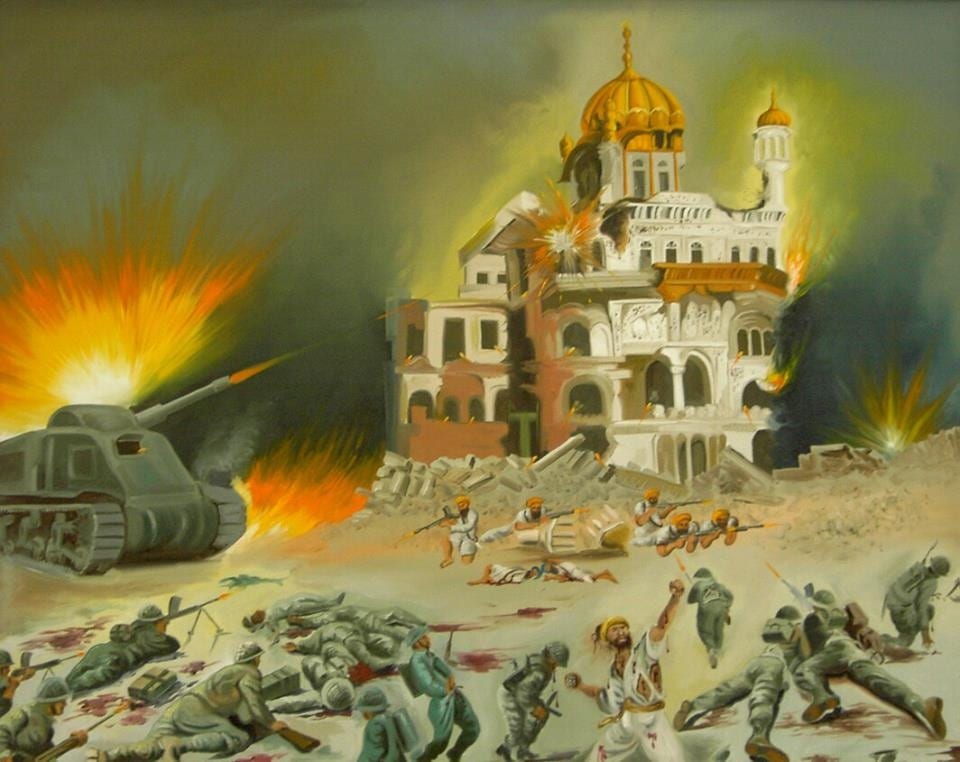
Defense of Harmandir Sahib (historical illustration)
These legendary battles are not just moments of war, but timeless examples of courage, sacrifice, and unwavering faith. Time and again, Sikh warriors stood firm against overwhelming forces, choosing honor and righteousness over survival.
What made these last stands truly extraordinary was the mindset of the defenders. They fought not for conquest or glory, but to protect freedom of belief, sacred spaces, and the dignity of the oppressed. Each battle became a symbol of resistance against tyranny.
- Battle of Saragarhi (1897) – A defining moment in military history where 21 Sikh soldiers of the British Indian Army chose to fight to the last man, delaying the enemy and inspiring generations with their supreme sacrifice.
- Battle of Chamkaur (1704) – Surrounded by a massive Mughal force, Guru Gobind Singh Ji and his Sikhs fought fearlessly, demonstrating the Khalsa spirit of standing against injustice regardless of the odds.
- Battle of Amritsar (1764) – A small group of Sikh warriors defended the sacred Harmandir Sahib, proving that faith and determination can outweigh sheer numbers and force.
These heroic last stands continue to inspire soldiers, historians, and ordinary people across the world. They remind us that true strength lies not in numbers, but in conviction, unity, and the willingness to stand for what is right.
The legacy of these battles lives on in Sikh traditions, prayers, and collective memory—serving as eternal reminders that courage guided by faith can shape history itself.
Legacy
The Sikh martial tradition is built upon the timeless principles of courage, justice, self-sacrifice, and the protection of human dignity. From its early foundations under Guru Hargobind to the formal establishment of the Khalsa by Guru Gobind Singh in 1699, Sikh military history represents a unique blend of spirituality and strength.
Sikh warriors were guided not by conquest, but by the responsibility to defend the oppressed and uphold righteousness. This philosophy transformed the Sikh community into a disciplined force that resisted tyranny during Mughal persecution, Afghan invasions, and later colonial expansion.
The concept of Chardi Kala—eternal optimism in the face of adversity— remains central to the Sikh worldview. Even after immense losses and hardships, Sikh forces consistently regrouped, reorganized, and rose again with renewed resolve. This mindset allowed the Sikhs to survive periods of near annihilation and eventually establish a powerful empire in the Punjab.
In the modern era, the legacy of Sikh bravery continues through significant contributions to armed forces across the world. Sikh soldiers have served with distinction in the Indian Army, British Army, and other global military institutions, earning recognition for their discipline, resilience, and fearlessness.
Beyond the battlefield, the Sikh legacy also emphasizes service (Seva), humility, and moral responsibility. The same spirit that once defended sacred spaces and communities now manifests in humanitarian aid, disaster relief, and peacekeeping missions worldwide.
Today, the stories of Sikh warriors, martyrs, and leaders continue to inspire generations, serving as reminders that true strength lies in standing for justice, protecting the innocent, and remaining steadfast in the face of injustice. This enduring legacy remains a powerful symbol of faith, resilience, and unwavering commitment to righteousness.